Reflecting on Indie Game: The Movie (2012)
It’s hard to encapsulate how nostalgic I can get for the early 2010’s. It’s the type of nostalgia that’s true to the origin of the word; a pain caused by a desire to return to a place and time. While I don’t think I necessarily want to return to that era, I can’t deny that it has some charming qualities. It was the last time that served as a sweet middle ground between the “old” ways of doing things and our now technology-dominated lifestyle. One could (I wouldn’t) argue that the early 2010’s was the last great era of gaming.
Sure companies would nickel and dime you for DLC, but at the very least the games themselves were typically of high quality. No 50+ gigabyte downloads, day one patches weren’t quite as common, and online multiplayer still felt new and exciting. It was the golden age of Western games and studios like Bethesda Game Studios, Naughty Dog, Rocksteady, Bioware, Ubisoft, Arkane, etc.
It was also a very early chapter in the legacy of independent video games. Of course, people have been cooking up their own video games on their home computers for decades prior. Comiket is a Japanese convention solely dedicated to people selling their homemade goods, which soon enough began to include video games. It’s where the earliest Tohou Project games were sold to the public. Another shining pillar in the history of indie games was released in December of 2004 with Cave Story. Indie games were historically tied to PCs, but Microsoft helped bring indies to the console space with Xbox Live Arcade. Starting in 2008, they ran a “Summer of Arcade” program which highlighted an exciting new (and oftentimes indie) game that players could download onto their console for a very low price. This was an era where summers provided players a dearth of games (something that I sorely miss), so it was refreshing for me to play something like Braid before bed on my summer vacations. Winter was the time for the big blockbuster titles such as Call of Duty or Assassins Creed.
This Xbox Live Arcade era of indie games was captured quite well in the 2012 documentary Indie Game: The Movie.
Indie Game: The Movie was directed and produced by both James Swirsky and Lisanne Pajot. The objective of the film is simple; to show the brutally honest behind-the-scenes look and the up and coming independent game development scene. We get this viewpoint from three different points in time and from three different developers:
In active development: Phil Fish of Fez
In the final stage of development and release: Edmund McMillen and Tommy Refenes of Super Meat Boy
Long after release: Jonathan Blow of Braid.
Despite my enjoyment of the film, I would argue that it is unfortunately bordering on antiquated now. While it definitely served its purpose in the early 2010’s, independent development has grown to such tremendous size that I’m sure a fair amount of it has changed. But one thing hasn’t changed:
An independent game isn’t just a product to these people- it’s who they are.
A big budget title like the then-contemporary Mass Effect 3 is by design meant to appeal to as many potential players as possible. And that very concept can be a contradiction to individuality and personality. Every developer in this film shares the same desire- to be heard. It’s like they’re trapped in their own mental prison and the only way they can send an SOS out to the public is through their game. After watching the film as a teenager and looking up peoples reflections on the film, it seemed to me that Phil Fish was the central focus for many. Fish comes off as a passionate ball of anxiety and dread. He mentions stories of him and his father creating I-Spy style games on an old Macintosh computer. One quote that stuck out to me is when he says:
“I want to have a say in video games.”
I think this encapsulated Fish quite well. It comes off a bit controlling. If he simply said “I want to be a part of video games”, it would have come off more sincere and well-intentioned.
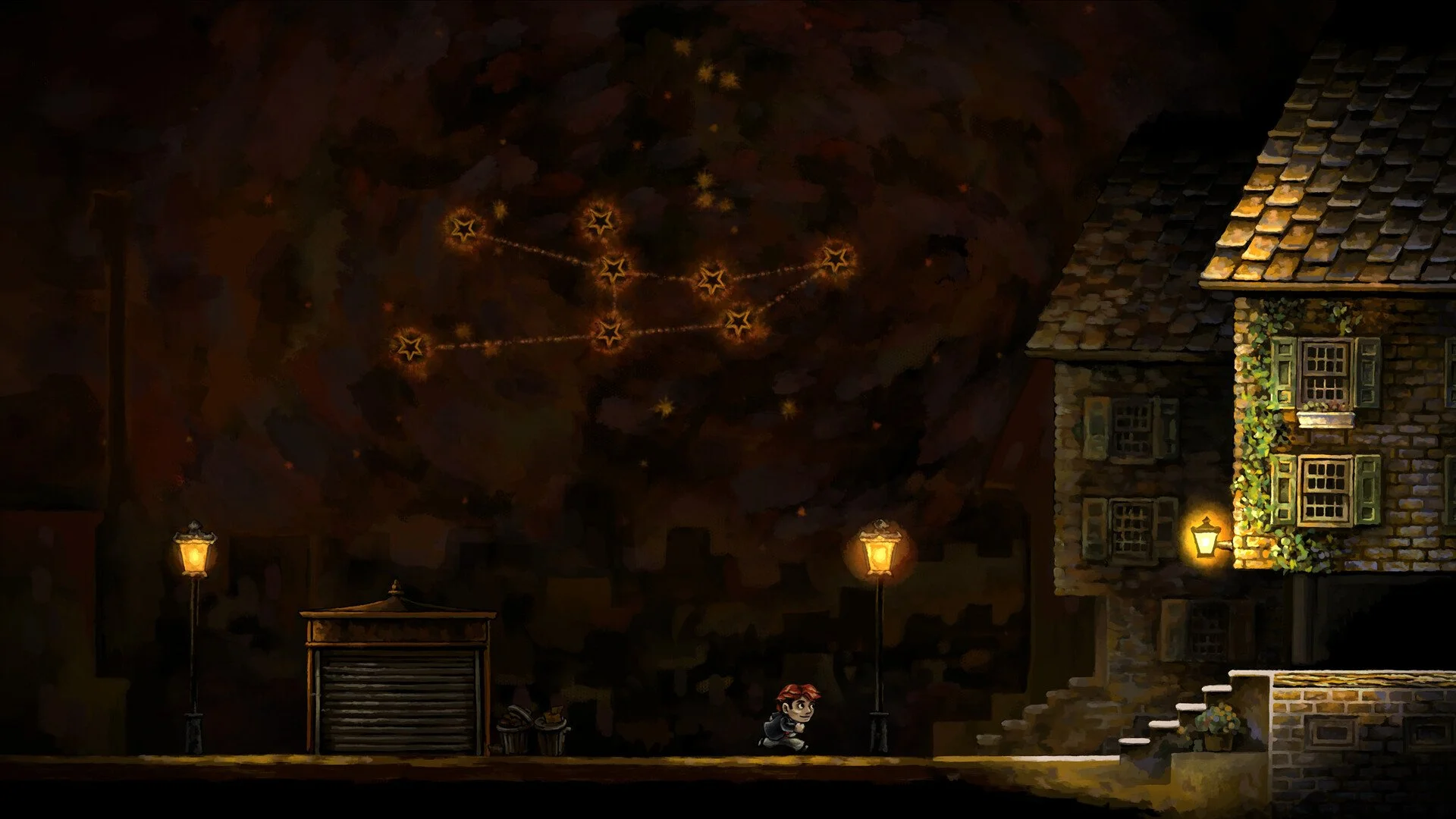
Braid was one of the pivotal games that helped me branch out my tastes as a young gamer.
I mentioned nostalgia before and it hit me like a truck multiple times in the film. The Xbox 360 was the prominent console of the film. Seeing 360 controllers and Wiimotes scattered about took me to yesteryear. Seeing the inside of Edmunds house covered in Newgrounds stickers and an Aqua Teen Hunger Force poster was endearing. Tommy’s room was covered in 90’s gaming posters and seemed unchanged from his childhood. Aside from Blow who is consistently shown in San Francisco cafe’s and empty dark offices, all of these people come off as normal people.
Of course we have to address the elephants in the room. Phil Fish went on to release Fez, which is still heralded as one of the greatest games of all time. Unfortunately, Fish couldn’t keep his anxiety and social media addiction from mixing into a dangerous combination. He had many a meltdown on Twitter and withdrew himself from the industry. He made a nasty yet understandably-timed comment on Japanese games, and oftentimes came off a bit too pretentious. And Jonathan Blow of Braid and The Witness has the same pretentiousness minus the meltdowns. And then there’s Tommy and Edmund from Super Meat Boy fame. Details are scant but the two had a breakup and never put out a game together again. Tommy seems hellbent on never leaving the Super Meat Boy IP alone. Meanwhile Edmund has become one of the biggest legends in indie game history with The Binding of Isaac and Mewgenics becoming huge hits.
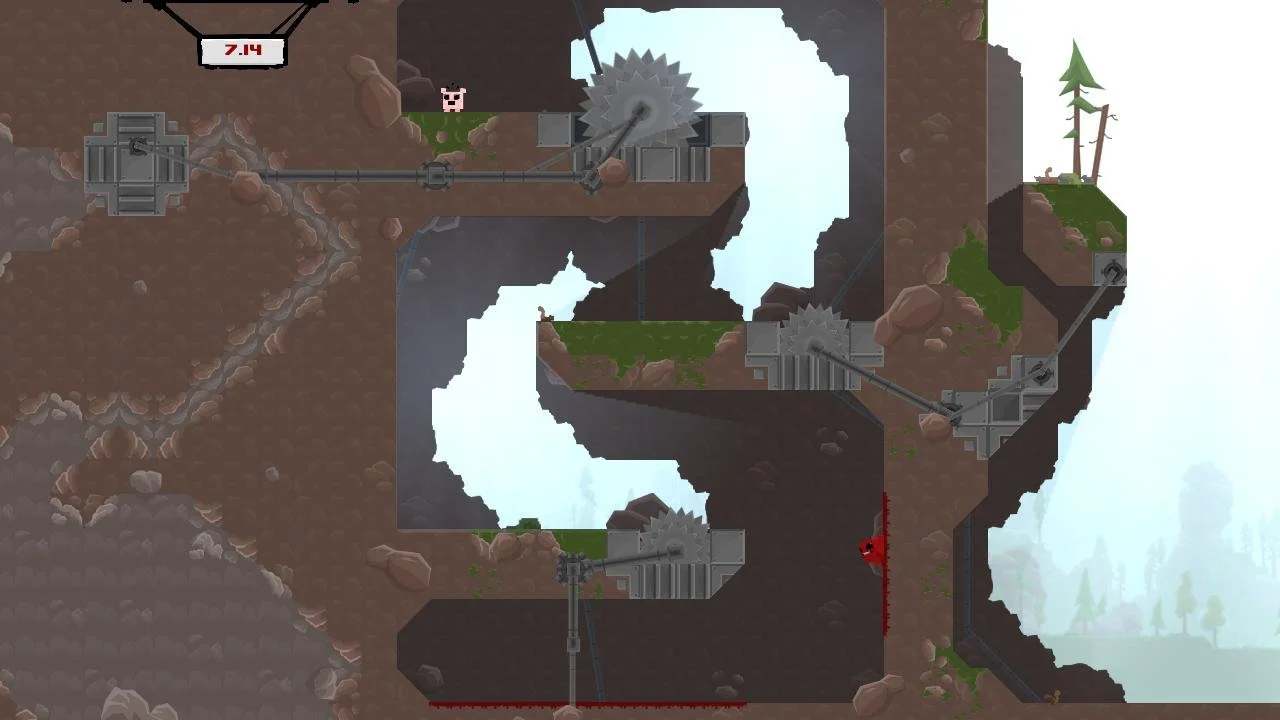
My friends and I spent countless hours trying to 100% Super Meat Boy (unsuccessfully).
Elephants aside, I still find the stories of these people quite fascinating. Fish seems genuine when he says he’ll end his own life if he cant complete Fez. Edmund and Tommy are heartbroken when Microsoft didn’t put their game on the front page of the Xbox Live Marketplace (as per a deal they made). But when the game is a success regardless, they are awestruck. I was smiling when Edmund was laughing at people on YouTube playing his game. And it was touching to see his wife cry when the reality hit her that her husbands hard work truly succeeded. As for Blow, I think his tale of struggling to process success is quite common for people. Despite being fourteen years old, I think the film still holds up as story of small artists trying to make a name for themselves.
I’d love to see a sequel or a spiritual successor with the modern titans of indie games. What does Team Cherry look like behind the curtain? Or LocalThunk, the solo developer of Balatro fame? How does the scathing and brutal online gaming landscape affect them?
The movie has its critics for many good reasons, but I can’t deny how much it resonates with me.